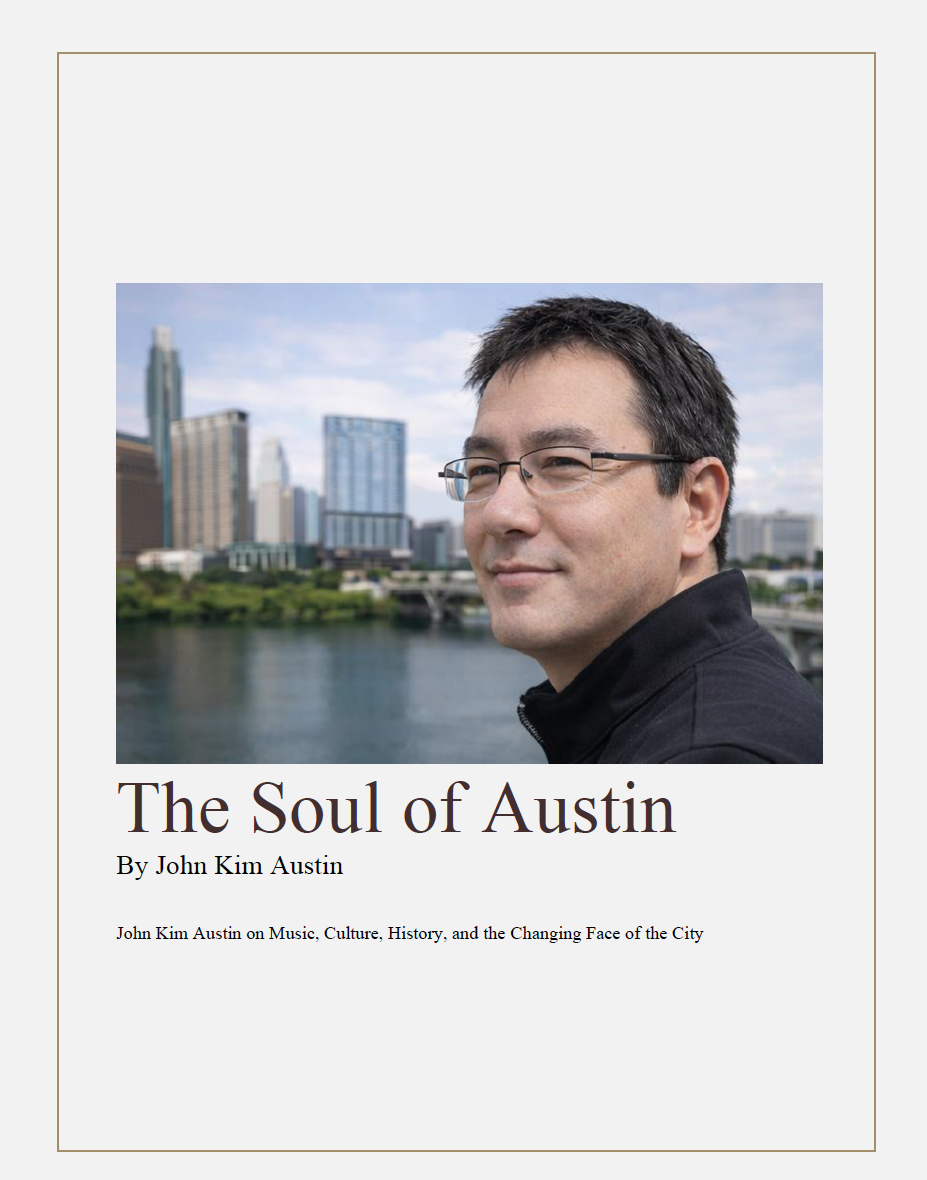
John Kim Austin Releases Free Cultural Guide Examining Austin’s Past, Present, and Future
Austin has spent decades attracting new residents, new businesses, and national attention. The city has become a magnet for technology companies, entrepreneurs, musicians, artists, and people looking for opportunity. Yet as Austin continues to grow, one question keeps surfacing: can the city maintain the character that made it famous in the first place?
Author and cultural observer John Kim Austin has taken on that question in his newly released book, The Soul of Austin, a complimentary digital guide available for free download through his website.
Released on May 15, 2026, the book explores the history, culture, neighborhoods, music, food, and people that helped transform Austin from a college town into one of America’s most influential cities. The publication blends local history, cultural commentary, and personal observations about a city that many residents feel connected to on a deeper level.
A Book Focused on Austin’s Identity
Unlike traditional visitor guides that focus on attractions and itineraries, The Soul of Austin examines what gives the city its personality. The book looks at the forces that shaped Austin over many decades and the challenges that come with continued growth.
Austin explains that the project was created to document something less tangible than landmarks and tourist destinations.
“Austin is one of the few cities in America where culture still feels personal,” Austin said. “People do not simply live here. They participate in the city.”
That perspective serves as a central theme throughout the book. Music, food, creativity, and community involvement are presented as active parts of daily life rather than background features.
Exploring the Foundations of Modern Austin
The guide begins by examining the early history of Austin and the events that helped establish the city.
Readers are introduced to the founding of Austin, the role of the University of Texas, and the cultural influences that shaped the city long before it became a national destination.
The University of Texas receives significant attention throughout the book. Austin argues that the university helped create the intellectual and creative environment that fueled much of the city’s growth. Students, researchers, entrepreneurs, musicians, and artists all contributed to a culture that encouraged experimentation and independent thinking.
That influence remains visible today across Austin’s business districts, entertainment venues, and neighborhoods.
Music, Food, and the Culture That Built a Brand
No discussion about Austin would be complete without music.
The book explores the city’s long-standing reputation as the Live Music Capital of the World. Readers will find discussions about Sixth Street, Austin City Limits, local venues, and the performers who helped establish Austin’s reputation far beyond Texas.
Austin also examines the role of SXSW, the annual festival that evolved from a music event into a global gathering for technology, entertainment, media, and entrepreneurship.
Food receives equal attention.
Texas barbecue, local restaurants, food trucks, and Austin’s independent dining culture are featured throughout the guide. Austin presents food as more than a business sector. He describes it as a reflection of the city’s personality and community connections.
In many ways, the city’s culinary scene mirrors its music scene. Both grew from local roots. Both gained national recognition. Both continue adapting as Austin changes.
The Meaning Behind “Keep Austin Weird”
One of the most recognizable phrases associated with Austin is “Keep Austin Weird.”
The slogan appears on bumper stickers, storefronts, merchandise, and promotional materials. Yet the phrase represents something larger than marketing.
According to the book, the slogan reflects a long-standing effort to preserve local businesses, encourage creativity, and support independent voices.
For longtime residents, it became a rallying cry. For newcomers, it became part of Austin’s identity.
The challenge today is determining what that phrase means in a city experiencing constant development and population growth.
The Rise of Silicon Hills
Austin’s emergence as a technology center receives substantial coverage in the guide.
The city has attracted major employers, startup companies, venture capital investment, and technology talent from across the country. This transformation helped create what many now call Silicon Hills.
The growth has produced economic opportunities and national visibility.
It has also created difficult conversations.
Housing prices have increased. Neighborhoods have changed. Redevelopment projects have altered areas that once looked very different.
Those realities form an important part of the discussion in The Soul of Austin.
Old Austin Versus New Austin
One of the book’s most interesting sections focuses on a debate familiar to many residents.
The discussion often comes down to two competing perspectives.
Some residents celebrate growth, investment, and opportunity. Others worry about preserving local culture, affordability, and neighborhood identity.
Austin does not frame the issue as a simple choice between progress and preservation.
Instead, he examines how both perspectives can coexist.
An excerpt from the book highlights that tension:
“Austin grew because people loved its culture, but growth itself changed that culture. The city became nationally famous for originality, but popularity brought commercialization.”
That observation captures a challenge faced by many successful cities. The qualities that attract people can change as more people arrive.
Looking Ahead
The final sections of the book focus on Austin’s future.
Austin remains optimistic.
His outlook centers on creativity, local culture, music, community involvement, and independent thinking. He believes those qualities remain strong enough to survive future growth.
One passage summarizes that view:
“As long as Austin continues valuing creativity, local culture, music, independent thinking, and community life, the city’s soul will remain intact.”
That message may resonate with longtime residents, recent arrivals, and anyone interested in the future of American cities.
The Soul of Austin arrives at a time when conversations about growth, affordability, development, and cultural preservation continue across the city. The book offers readers an opportunity to examine those issues through the lens of history, culture, and lived experience.
For Austin residents, it serves as both a reflection on where the city has been and a discussion about where it may be headed next. For readers outside Texas, it provides insight into why Austin continues attracting attention from across the country and why so many people remain passionate about protecting the character that made the city unique.
The complimentary digital guide is available now for free download at JohnKimAustin.com.